Tuesday, November 27, 2012

Ibsen's Pillars of the Community: Homecomings Are Not Always Joyous Affairs.


I'm back! With a new gig from the Cape Cod Times which will help me keep this poor blog au current.

 The review below was originally published in the Times


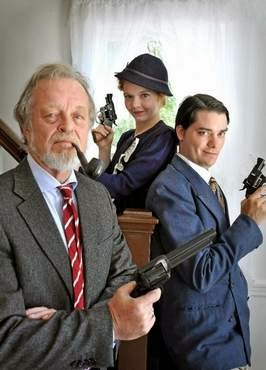
Chris Kanaga (left) and Danielle Dwyer. photo: Elements Theatre Company

ORLEANS – ‘Tis the season for complicated family relationships on display, and Henrik Ibsen’s Bernick family in the “Pillars of the Community” is no different from yours or mine, except perhaps that the patriarch is a prototypical capitalist monster.

The Bernicks consist of difficult stepsisters and black sheep brothers, cousins and ex-beaus, nosy neighbors and judgmental in-laws, all with secrets that threaten to disrupt celebrations. Sound familiar?
In the Elements Theatre Company’s ambitious take on Ibsen’s sweeping play, Karsten Bernick, head of house and town, faces a test of character, providing 19th century dramatic narrative and at the same time managing to be applicable to contemporary headlines.

“Pillars” does not have the impact of Ibsen’s later masterpieces (the plot is too neatly tied up) but the timeless relevancy of Ibsen’s themes – do current good works alleviate past sins, for example – make the play worthy of dusting off and can be used as ammunition for anyone who has a strong opinion on the Lance Armstrong situation.

Keeping the many characters in “Pillars of the Community” straight can be a challenge to an audience member who isn’t familiar with this rarely produced play.
Many characters serve little more than to personify the rigid moral fiber of the Bernicks’ Norway town, but the production does a great job of highlighting the humor in a mob mentality, and there are some standouts in the diligent cast.

Chris Kanaga as Karsten Bernick navigates convincingly between hubris and vulnerability: “One anxious moment, one stray word,” and he may lose everything. 


At his side, his wife Betty, played by Rachel McKendree in a rather thankless role, is consigned to little more than reacting to blasts from the past by the return of her brother (Peter Haig).

Also returning to “lift the veil” from a murky past is Karsten’s past love, Lona Hessel, played by director Danielle Dwyer. Dwyer presents Lona as one of Ibsen’s paradigmatic feminists and rightly so: She easily handles the snappy dialogue and delivers the “fresh air” as promised, however the character verges on the self aware and congratulatory to the extent that she seems to have arrived not from America but from another play.

Other distinctive performances include Kate Shannon as Marta Bernick, Karsten’s sister who somehow manages to stand on “terra firma” in her independence from her family, and Brad Lussier who is both the repressed schoolmaster, Mr. Rorlund, and Aune the shipyard foreman and pre-union organizer. 

Finally, another star of the show is the set. With a design that wouldn’t be out of place on Broadway, Hans Spatzeck-Olsen, Karlene Albro and Jennifer Lynch have created the Huset Bernick, a wonder, complete with balcony for Karsten to look down on his family and friends both literally and figuratively until he is forced to come back to Earth.

Friday, June 10, 2011

A Fairy Queen from Queens in Manhattan

Coming into Manhattan like a ship at Fleet Week, The Queens Shakespeare Company arrived this week-end with its large troupe to finish up a successful run of its spring A Midsummer Night’s Dream. Moving from Flushing’s Bowne Street Church to the Secret Theatre in Long Island City, and then to the Grand Theatre at The Producers Club on 44th Street, the theatre company, despite an uneven cast, fulfills the comic promises of one of Shakespeare’s greatest entertainments.

Director Jonathan Emerson (who also plays an exuberant to the point of hyperactive Puck) efficiently steers the large ensemble into the small space of the off-off-Broaday theatre in the wild west of Hell’s Kitchen of New York City. In his director’s notes, Mr. Emerson declares his love for the mythologies touched upon by Shakespeare’s fantastical fairy characters contained in the parallel plots of A Midsummer Night’s Dream - the Fairy Queen Titania (Helyn Rain Messenger), her fractious (but sometimes seemingly bored) King, Oberon (Brian Walters), and their entourage. The dynamism of Flogging Molly, the Celtic-American LA Punk Band, anticipates the production, and the rest of the evening attempts to maintain that punk sensibility, most successfully by the clownish Helena (Kathleen Fletcher) in mad pursuit of her undeserving but beloved Demetrius (Bradley LeBoeuf.)


Continued here

Friday, February 18, 2011

"Your Story Has Kicked Up Quite A Fuss Around The Office" - The Library of America's Shirley Jackson: Novels and Stories

The Library of America collection, Shirley Jackson: Novels and Stories, is an initial disappointment. Editor Joyce Carol Oates, normally so prolific, is surprisingly silent here.

There is little to suggest in this volume as to Oates' own distinct persona: no introduction, no endnote, no homage. This is remarkable because, in rereading Ms. Jackson's works, the Princeton professor seems to owe a great deal to the woman whose short story "The Lottery" still scares high school sophomores all over the country.

Both women have an unique upstate New York voice. Oates was born and grew up in Lockport, N.Y. Jackson, born in San Francisco, graduated from a Rochester, N.Y. school. Both share an alma mater: Syracuse University. The outsider aspect of being from New York but not a part of the New York that the rest of the world sees (New York City) formed both writers' mischievous identity.

Oates has written extensively on Jackson previously; here is her New York Review of Books take on  We Have Always Lived in the Castle, one of the two novels contained in the LOA book, and my favorite of Jackson's works.


Ultimately, the disappointment at a lack of Oates here is brief. We are reminded that Shirley Jackson, who passed away in 1965 at a too young 49, is a signficant writer. The Library of America, a nonprofit publishing company whose mission statement is to "preserve America's best and most significant writing" seems to have a match made in gothic heaven with Oates and Jackson, and the volume prompts again that Jackson is long overdue for some serious respect in the literary canon.

Hers is the latest installation in the Library's roster which includes the likes of John Steinbeck and William Faulkner. Would the Vermont writer, imprisoned in the close environs of Bennington College (neither she nor her husband drove) be delighted at the inclusion? I hope so. Or perhaps she would have just shrugged her shoulders, lit a cigarette and started a new story, hopefully one that would pay well.


Review continued here: 

Friday, December 3, 2010

History Just Got All Sillypants


What's that up in the air? Is it Spider-man from Turn Off The Dark?! Be careful of your wrists!  Oh..no...it's just Andrew Jackson's horse hanging from the fairy light rafters of the Bernard B. Jacobs Theatre West 45th Street. Be careful of your fetlocks! It's a splendid performance  - a worthy follow up to his star turn in Sam Shepard's Kicking a Dead Horse.

Ben Brantley raved about Bloody Bloody Andrew Jackson when it was at the Public. That quite possibly could have been a different show than I saw last night which was a cross between Schoolhouse Rock and South Park.


I slipped in to see the seventh President of the United States and his dead horse before BBAJ closes after the Christmas run on Broadway.  There are many interesting parallels between Jackson and current political events, but they are obscured by an unremarkable score and remarkable fairy lights.

Benjamin Walker, as has been mentioned many times in many medias, has a breakout role as Jackson the Indian Killer, but it was really Bryce Pinkham (below) who helped me keep my annoyance in check, both at what was happening onstage and off - the person seated to my right laughed uproariously at every joke.


Pinkham's portrayal of Black Fox, the ahistorical amalgam of many Native American elders with whom Jackson bargained and ultimately conquered, saved me from the wretchedness of situations like the Wellesley lesbo-historian in the wheelchair (didn't I see this narrator in a wheelchair before in The History Boys AND Rocky Horror done with better jokes?). Facing the onset of the Trail of Tears, Pinkham's character inhabits quiet, sincerely emotional scenes in the midst of raging faux-emo chaos. He doesn't have to say a word to get his point across. The other characters? A few million nonsensical words will do.

Pinkham, Walker, the musicians, the antler chandeliers, the opening number, these make up the best moments of BBAJ. A low moment? The Founding Fathers inexplicably dressed with ruff collars, popular some two centuries prior to Jackson. Henry Clay (also Pinkham) has some kind of fetish about mink. Why quibble about collars, ruff or fur, when the whole show is anachronistic? Look at John Calhoun, Jackson's Vice-President. Do you really need to dress him in silly clothes to make him funnier?


Bloody, Bloody Andrew Jackson, written and directed by Alex Timbers with music by Michael Friedman, will be running until January 2.

Thursday, November 11, 2010

What Kinda Neighborhood Is This?


There is a theater benediction for those working downtown, Off Broadway, Off Off Broadway, and in community theater, and I paraphrase: may your audience always outnumber your cast. Producing Lanford Wilson's Balm in Gilead, with its 29 roles, the T. Schreiber Studio would seem to be tempting fate; instead director Peter Jensen has orchestrated a raucous symphony of a play that draws a capacity crowd to its feet.

It's hard to believe, with Manhattan the way it is now, that when Lanford Wilson wrote Balm in Gilead in 1964, his play reflected an Upper West Side reality. The scene, an all-night diner frequented by prostitutes and drug dealers, is a cacophony of human desperation against a backdrop of urban decay. A deliberate exaggeration in the number of characters, all with overlapping dialogue, Balm in Gilead was a dramatic expression of a modernist abstract painting. Now it is a show already in progress.

Like picking out the sound of a particular instrument in an orchestra, it is difficult to cite specific performances—the huge cast is too daunting in numbers to give due credit. Some roles, like Babe (Lisa Sobin), who spends most of the evening slumped on the diner counter in a drug stupor, are on the periphery of the play, reflecting the unhappy state of the disenfranchised. Other roles are singers who lead in with a cappella doo-wop and move and weave, to rock music, through the actors, bookending and then propelling the story with song. Still others are characters who do a St. Vitus dance to Wilson's splendid soliloquies. All make up a complex tapestry.

When Dopey (Lawrence Crimlis, pictured above) speaks, a spotlight shines and the players all freeze at attention, a surreal moment that heightens the chaos that is inevitable when the action continues. We don't always see it, but each character is in his or her own spotlight all the time, and Jensen does an exceptional job emphasizing just how intensified an environment each character experiences even when all the audience can discern is the noise of a busy diner.

Ann, the prostitute with the heart of gold, stops short of being a caricature of that prostitute through Jill Bianchini's performance. There is something in the stillness in which she holds her body that stands in striking contrast to all the nervous energy around her, both natural and drug-induced.


Ann listens to the story of Darlene, the new girl on the block who is destined to take Ann's place. All quiet attention, Ann slowly spoons warm soup into her hungry mouth, and in a remarkably quiet moment, takes in sustenance while exuding it, all patience and empathy to the tragedy that Darlene, lonely, heartbreaken, lies at her feet.

Darlene (Belle Caplis, above right) is a rookie to the neighborhood, recently moved from Chicago, a broken romance behind her and more heartache ahead. Ms. Caplis had a sing-song cadence to her lines, perhaps to emphasize her smalltown artlessness, her otherness. It wasn't until Darlene gets to tell her story, in a stream of consciousness that would make Joyce proud, if not puzzled, by the tale of an overlong line at the Justice of the Peace, that Ms. Caplis got out of the cartoonish rhythms that overwhelmed the character earlier.

Two other standout performances were Sebastian Montoya as John, behind the diner counter, and Jonathan Wilde as Joe (above left);  the characters are parallel in their disbelief at some of the events that surround them. Both are able to temporarily cut swathes through some of the chaos that surrounds them, but in the end it isn't enough.

Today, that diner may not be found, at least in the contemporary Upper West Side, but it does exist. It's just moved. Recently re-watching David Simon's brilliant television series, The Wire, I saw the same characters that populated Wilson's play—the drug dealers and prostitutes, the unwanted members of society, caught in a cycle of poverty and crime that begins in New York City and moves to Simon's Baltimore. Wilson's play, his first, is as relevant today as it was addressing humanity in impoverishment in the 60's.

With musical direction by Stephanie Seward, Balm In Gilead runs through November 21.

Additional cast includes: Amanda Catrini, Jevon McFerrin, Alona Metcalf, Jason Pumarada (singers) Seth Allen (Martin), Ian Bell (David), Esteban Benito (Tig), Dennis Brito (Frank), Tommy Buck (Al), Lowell Byers (Bob), Ian Campbell Dunn (Fick), Jordan Feltner (Rake), Brad Martocello (Tim), Mariel Matero (Kay), Erica Lauren McLaughlin (Bonnie), Michael W. Murray (Stranger), Orland J. Rivera (Carlo), Olivia Rorick (Judy), Stephanie Seward (Terry), Eric Spear (Franny), Christine Vega (Rust), Stewart Villilo (Ernesto), Richard Zekaria (Xavier).


First published on blogcritics.org

Thursday, October 28, 2010

Weekend at an English Country Estate: Icing on a Favorite Cake

The song that playwright Sara Montgomery metaphorically sings in her Weekend at an English Country Estate is a familiar one.  The play is a drawing room comedy reminiscent of Noël Coward's Hay Fever or Philip Barry's The Philadelphia Story; and while the song may be familiar, it is pitch perfect, proving that sometimes a cover version can be a joy too.

Noël Coward and The Philadelphia Story—not bad comparisons for a playwright's first fully-produced work.

The characters that wander in and gather at the aforementioned English Country Estate may seem standard: the divorced Lord Hightower (Jacques Roy) and Lady Hightower (Elizabeth Neptune) visit their Great House with their children, dysfunctional no doubt from all that inbreeding going on within the British upper class.

One daughter, Evelyn (Alyssa Lott), is quite bookish, and, in the kind of social jibe that keeps Weekend contemporary and off the dusty shelf, is not allowed to call her mother and father Mum or Dad because they prefer to be her friends, not parents.

Another daughter, Athena, is not domesticated. We might even call her feral, in fact; the character seems to have wandered in from the vividly satirical imagination of Stella Gibbons' Cold Comfort Farm. Athena is played with great physical comedy by the playwright herself; it is a physical performance because, with a delightful irony, Athena is mute, stricken by an unfortunate Pomeranian incident long ago. The playwright who has no words is just the kind of subtle joke that elevates Weekend beyond the average farce.

We also have the Lord and Lady's Significant Others: Veronica (Madeleine Maby) and Charles (Charlie Wilson), beautiful young things who have an agenda toward remarriage and its money. Love and lust are in the air as surely as the scent of the beautifully maintained English country garden.

Veronica has a hanger-on, Damon of the hooded eyes (Joe Stipek,) who is the morose foil to all the champagne-induced exuberance around him, and just in case the playwright hasn't poked fun at artistic ambitions enough, let's make him a poet because poets are such an easy target for laughs, and rightfully so, because Damon rhymes Veronica with harmonica.

To accentuate the Upstairs, Downstairs motif, there is Maddox, the communist butler (Mick Lauer), and Mary, the wise Irish maid (Julia Moss), who are the comic Greek chorus, commenting on the melee around them.


Sara Montgomery acknowledges her debt to Coward and to P.G. Wodehouse as well; she doesn't mention The Importance of Being Earnest, perhaps to be modest. It may be unseemly to reference the greatest drawing room comedy of all time, but I will bring it up as one of the reasons why the casting seemed so natural—two of the actors here, Jacques Roy and Madeleine Maby, had been in last year's very fresh and funny Earnest at the Counting Squares Theatre. They, along with Elizabeth Neptune who seemed to be channeling all the best comic timing of Bette Davis, brought the comic tension between the old-timey, as Montgomery calls it, and the absurd, and this is where laughter comes in.

And speaking of laughter, I hadn't heard that much laughter in the theatre in a long time; granted I have just finished up a stint as a juror for an Irish Theatre festival, Irish theatre, generally speaking, being a bit on the serious side, but from the very first line, when Mary opens with "I wonder what the poor people are doing tonight," the audience was obviously delighted. From the first line to the standing ovation, Weekend at an English Country Estate was endearing entertainment. We even laughed when a silver strappy sandal, thrown dramatically across the room, took an unexpected bounce and sailed uncomfortably close to our seats. If the shoe hits, laugh at it.

The Ateh Theatre Group presents Weekend at an English Country Estate, directed by Paul Urcioli, playing at the Access Theatre through October 31st.


First published on blogcritics.org